Ocean Vuong: A Letter to Someone Who Can't Read It
with Ocean Vuong — Poet & novelist
July 8, 202601:52
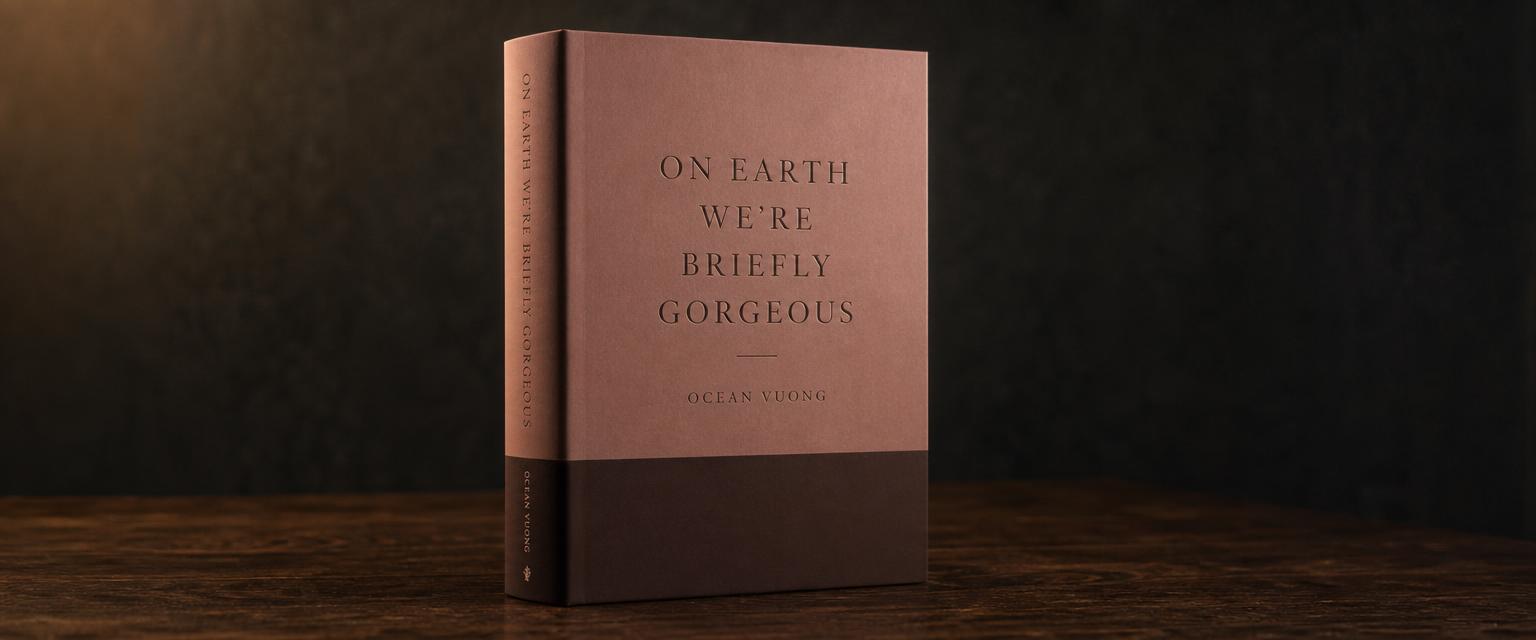
Discussed in this episode: On Earth We're Briefly Gorgeous · Penguin Press, 2019
00:00--:--
A two-voice studio conversation: Nora Ellis and Ocean, with clickable questions below. Our interviews are written and voiced dramatisations, drawn from each author's publicly documented remarks on craft.
From poetry to the novel, writing scenes where nothing beautiful happens, and building something permanent for people a country treated as temporary.
The interview
Nora Ellis in conversation with Ocean Vuong · click a timestamp to jump
Nora Ellis
You came to fiction from poetry. What did the novel demand that the poems didn't?
Ocean Vuong
Time. A poem can stand in a single moment and hold it up to the light. A novel has to survive Tuesday — it has to move people through years, through boredom, through a mother going to work. I had to learn how to write a scene where nothing beautiful happens and it still matters.
Nora Ellis
The book is a letter to a mother who can't read it. Why that frame?
Ocean Vuong
Because it's honest about the gap. My mother worked in a nail salon and couldn't read English, so any book I wrote was already addressed to someone it couldn't reach. Once I admitted that, the form made itself: you write towards the person anyway. That impossibility is the engine, not the obstacle.
Nora Ellis
You've said you compose very slowly — sometimes a few words in a morning.
Ocean Vuong
I do. I write on a laptop but I lay the sentence out like a line of poetry, and I won't leave it until the sound is right. It's inefficient and I've stopped apologising for it. The pace is the price of the music.
Nora Ellis
What is writing for?
Ocean Vuong
To make a place where the people I come from are permanent. I grew up around bodies that the country treated as temporary — refugees, factory workers, my grandmother. A book is one of the few structures we're allowed to build with nothing but language, and it lasts longer than a lease.
Nora Ellis
One thing to a young writer?
Ocean Vuong
Read your work aloud to someone who loves you. You'll hear every false note in about ninety seconds.
with Chimamanda Ngozi Adichie — Novelist & essayist
Four years, one abandoned narrator and a shelf of Biafran war memoirs. Adichie on research as a cure for fear, the danger of the single story, and why she threw away two years of work.

Frame stories, longhand mornings and why she'd rather be called a filing clerk than a prophet. Also: read your contracts more carefully than your reviews.